Saturday, January 29, 2011

Joy on a Saturday morning

 About once a week or so, I remember that I actually have a page or profile or whatever they call it on Facebook, and think, oh geeze – I had better take a look. Yesterday, being one of those days, that’s what I did. Naturally, one thing led to another, and the latter part of the afternoon totally evaporated - which is why I try not to do this too often.

One of the messages that hooked me was that my son-in-law, Micah Silver – a composer of music and soundscapes - had just posted a link to a project that he has been working on. For the past few months, he has been designing soundscapes for a restaurant called, What Happens When. It is at 25 Cleveland Place in Manhattan. My daughter, Sabrina, had first told me about it months ago, but until then I had never heard of the concept of designing a soundscape for a restaurant. Then again, I have never even been to Manhattan. At least, not yet.

I may have only grasped the half of it all, since I am pretty much musically illiterate, and am also old enough to draw a pension this year. These two things together mean that I can usually benefit from a tune-up by the younger folk when it comes to anything cutting edge. Regardless, the long and the short of this concept is that Chef John Fraser, who is one of the top drawer chef-types in New York, decided that he wanted to break out and have a bit of fun. Not that he doesn’t have a full plate already, since he already has a Michelin acclaimed restaurant, called Dovetail . I haven’t yet been there - obviously, first I would have to get to Manhattan - but his website is worth visiting, even if just to enjoy a vicarious feast.

This time round, Chef John’s idea of having fun included renting a space that had housed an abandoned restaurant. The cost of the space was low, relative to what costs are in that neck of the woods, because the lease could only be guaranteed for nine months. He then teamed up with a couple of designers from the Metrics Design Group, as well as Micah , and between the four of them, they created an environment where the three elements complemented one another: the food, the physical space, and the soundscape. Not only did the four of them create a plan for the first month, but they will be redesigning the whole enchilada every month –a different menu, different space, and different sounds. Only the address will stay the same.

In the first month, patrons will enter to the sounds of a sonic shower, and then as they go on to enjoy the rest of their dining experience, they will be surrounded by a compilation of sounds harvested by Micah from all sorts of sources. This will include the sound of snow as it falls and slowly covers plastic foliage, foliage which Micah once brought to Walden Pond in Concord MA for the purposes of recording this particular sound. There will also be recordings extracted from YouTube videos made by teenagers at rural bonfires. And for those who missed Micah’s recent installation, The End of Safari – it was at Mass MoCA, and I missed it too - there will be extracts from that soundscape as well.
Then, there is the bathroom. Don’t miss the bathroom. When you enter, you will hear a duet, but not only that, when you enter one of the stalls, you will hear only one of the voices from the duet. The other voice, natch, will be heard in the other stall.

If you want to read more about all this, there was a long article January 5th in the New York Times. Enjoy. UPDATE: If you come to this restaurant expecting the experience of the compositions and sound space created by Micah Silver, I regret that you are too late. To all good things ....

Friday, January 28, 2011

The Voice of Patrick Flynn


On my recent trip to Ireland, I made a last minute plan to drop in at Liscalgot in South Armagh to see Seamus Cumiskey. Before I had left Canada, he and I chatted on the phone several times about a diary, and a set of old family pictures that had recently been found, many of which were likely to be of people who interested me.

For years before this visit, I had also hoped to meet Mary Cumiskey, Seamus’ grandmother and the author of The Famine in Creggan Parish, as well as more than half a dozen articles in The Creggan Journal. Our interests overlapped, her writing was lucid and accessible, and since she lived in the area that I was focused on, she likely knew all sorts of stories that it could take me a life-time to understand, and I would still never get right. Unfortunately, every time I visited Ireland, Mary was somewhere else, like Italy. She may be a decade and change older than me, but this never stopped her from gadding about.

This time, when I arrived at Liscalgot - which also happens to be the home of Mary’s son and grandson - there was Mary herself having a cuppa in the kitchen. Our chat turned to this and that, but kept coming back to her most recent publication, Creggan Charter School 1737-1811.

Surely, it is worth the airfare to head out to Ireland just to buy a copy of Mary’s book, and the Northern Ireland Tourist Board will definitely thank you for taking the trouble to get there. You won’t find her books on the Internet, but they can be purchased from The Creggan Local History Society, at the Chairdinéil Ó Fiaich Heritage Centre in Cullyhanna, and okay, you can probably order copies by email: info@cregganhistory.co.uk – but that is nowhere near as much fun.
Mary Cumiskey - November, 2010

Later in the day, I visited Mary at her home, bought a copy of her book, and since then have read it three times. Not only was my 5th-great-grandfather the first schoolmaster at the Creggan Charter School when it opened in 1737, but he and several other family members ran it until it closed. Not that their part in it is an item of great pride amongst us, as you will soon see.

Before I climb on my high horse and look down on my ancestors, I do recognize that every age has its own arrogance and blindness. The powerful have always drawn lines in the sand that serve their own enrichment. In our time, the impoverished peasants who make our food, clothing, electronics and such, labour out of sight, out of mind in far away countries. A few hundred years ago, the rich did not have the luxury of distance to pretend that all their gains came as a result of their own merit, but their social beliefs accomplished the same end.

One such belief held by the powerful in 18th C. Ireland was that Protestants were destined to rule and Catholics were to be kept out, kept down and never more shall reign. This is not so surprising when we recognize that the separation of Church and State had yet to be realized in any practical way in Europe, or even America for that matter. At the same time, Presbyterians and other Dissenters, since they swore allegiance to neither the Pope nor the Church of England, were considered as neither Catholic nor Protestant and were therefore treated as neither fish nor fowl – they could lease land, to a point; make money, somewhat; but rule, absolutely not.

In this context the Charter Schools were started by a confluence of the most zealous of the Protestant landlords, bishops and such to educate Popish orphans in the Protestant faith and thus reclaim them from that gross ignorance and error wherein they are involved. This stated purpose served the local church wardens and school masters well. They could continue to pat themselves on the back for their good deeds in funding and running the schools, while at the same time reaping the rewards of the harvests and products produced by the children’s labour.

The little that I know about the early history of my Jacksons is that they had arrived in Creggan sometime before 1737, and that George Jackson became schoolmaster of the Charter School on the heels of losing the family lands in a game of cards, or at least so the story goes. His eldest son George was the next schoolmaster, but he didn’t last long.

Thanks to Cumiskey’s research, I have learned that soon after his appointment, George jr. was charged by James Johnston with immorality involving James’ daughter, Rose. From the family trees that I have, it seems that not only was this James Johnston one of Board Members of the school, and a warden of Creggan Church, but he was also probably related to the Jacksons by marriage. The family seats of these two families in the church, as well as their plots in the graveyard were cheek by jowl. This may go a long way to explaining why the next sighting of George jr. is when he shows up as a lawyer in Dublin.

The next son, David then took over, but he didn’t live at the school. This unusual arrangement was agreed to, possibly because the locals knew the reputed temper of his wife, Margaret Bradford. A move from Urker to Liscalgot would have been over her dead body, which would have been a reasonable stance for her to take, given that the couple had three young children to care for, and the school buildings were no great shakes when it came to warmth and sanitation.

Interestingly, David Jackson’s will makes no mention of his role as a schoolmaster, even though documents at Trinity Archives reveal pay chits that would indicate otherwise. His will describes him as both a farmer and maltster, and he owned several leases with their per annum revenue, and/or potential for farming at Cashill, Averinmore, Tullyagallaghan, and Cullyhanna. His level of well being was in marked contrast to the lives of the children in his supposed care.

An unscheduled inspection of Creggan in Sept 28, 1781 revealed children in rags, many of them barefooted, the beds extremely dirty and the house in general, dirty and in great disorder... Things did not improve, at least according to an 1787 report.  By then the buildings were in ruinous conditions,  the privy was inaccessible in Consequence of Puddles and Flashes of Water settled all about it and conditions were so bad on account of the fireplace not working properly and the over-crowding in a 22’ X 15’ sleeping room housing more than ten boys, that most of the boys now labour under severe colds.

Cumiskey dedicated this book to Patrick Flynn, a student who in May 1810 spoke out about his treatment. Amazingly, his cry for help was heard. By December 19, 1810, the schoolmaster was instructed to send all the boys to another school. In 1811, the Creggan Charter School was closed. Patrick Flynn is a voice that deserves to be heard today. So is Mary Cumiskey’s.

Monday, January 24, 2011

Twelfth Night AfterMath

My title for this blog is decidedly tongue-in-cheek, as you will soon discover. Those of you who were at our Twelfth Night party, as well as those of you who also know of my disgusting propensity for puns – great, groaning puns at that – will probably guess what I am alluding to. The rest of you will just have to read on. All will be revealed.

First things first though - the bonfire was great – thanks to all the dried out Christmas trees contributed by various neighbours, and encouraged by lashings of old oil from last year’s oil changes. A picture is of course, worth a thousand ...
Andreas -as his Mennonite father always feared .... photo credit Jasper Reynolds

But before the fire was started, we all regrouped for some live music, and that music is the prime reason for this particular blog.

For the past few years, Katherine & Peter – who recently crossed the threshold to became officially husband and wife  - have performed a song or three at Twelfth Night, usually just after we all join in a rendition of The Viking Song, and then collectively bay at the moon. The Viking Song sort of sets the mood for everything that comes next. This year, K&P also wrote a song with lyrics featuring none other than The Schroeder himself.

It wasn't just that Katherine had grown up hearing stories about the famed Schroederian heroics with respect to construction and house repairs, but that she and Peter also heard about and saw the house repair work that he did last June, after the wedding of our eldest daughter. It was staggering - even by Schroederian standards.

A few months before their wedding, our daughter and her then-fiancé had sensibly bought a three story house in Boston. It came with three suites, including one for them to live in, but it was over a hundred years old, and was in serious need of repair. The thing is, that if you ever dangle either the word repair or even the thought of it in front of the nose of The Schroeder, it is akin to dangling a wriggling mouse in front of a cat. 

In this case, Andreas aka The Schroeder, packed up a few tools, did some pre-planning with the kids, and then stayed in Boston for five days after their wedding. In that brief time-span, he accomplished the following:

For starters, he found a weakened beam supporting the first story, and then jacked up the whole house with some phenomenal jack, and installed supports for the beam that were substantial enough to take the house well into the twenty-second century. He also tore away a rotten stoop at the entry from the outside deck to the third floor suite, removed all the dry rot, installed fresh wood, made it all good to go, and then built an overhang so that such rot would never happen again. Not necessarily in this order, he then jack-hammered a circular hole in the basement concrete, dug down with a mattock, and installed a sump pump to address the issue of periodic flooding. In a stairwell leading to the third floor, he built and installed a bookcase and also ripped out a bunch of the stairs, and arranged for them to be realigned  so that sofas, appliances and such could now get through. Not content with that, he also installed a wall and a French door to create a mud room for the use of those on the 3rd floor. In between times, he showed our daughter and her husband - who were amazing in that they were actually able to almost keep pace with him - how to do a myriad of small home reno tasks such as caulking shower stalls and the like. I am probably missing some of what was left in his wake after this five day stint – but at least you can get the drift.

In the video that follows, the lyrics of: Small German with a Heart of Gold mention his habit of grabbing a gallon of milk, going from dawn to dusk on nothing more, as well as the fact that he stands 5'6" in his stocking feet. In this video, you can see a bit of Katherine seated in front of Peter showing flash cards to illustrate the core concept of each verse. The latter are a little hard to see here. I wish the lighting and framing were better. Maybe next year we can work on that, but at least it conveys the overall flavour. 


Another of their songs should be played in every school where children struggle with Math, which of course means every school in the whole wide world. If it was, there would be no AfterMath – instead there would be AlwaysMath – and as a result we could all breath a sigh of relief. Bridges would not fall down, recipes would always be correctly interpreted, and musical notation, with all its fractional notes and semi-tones would make more sense to the musically illiterate.


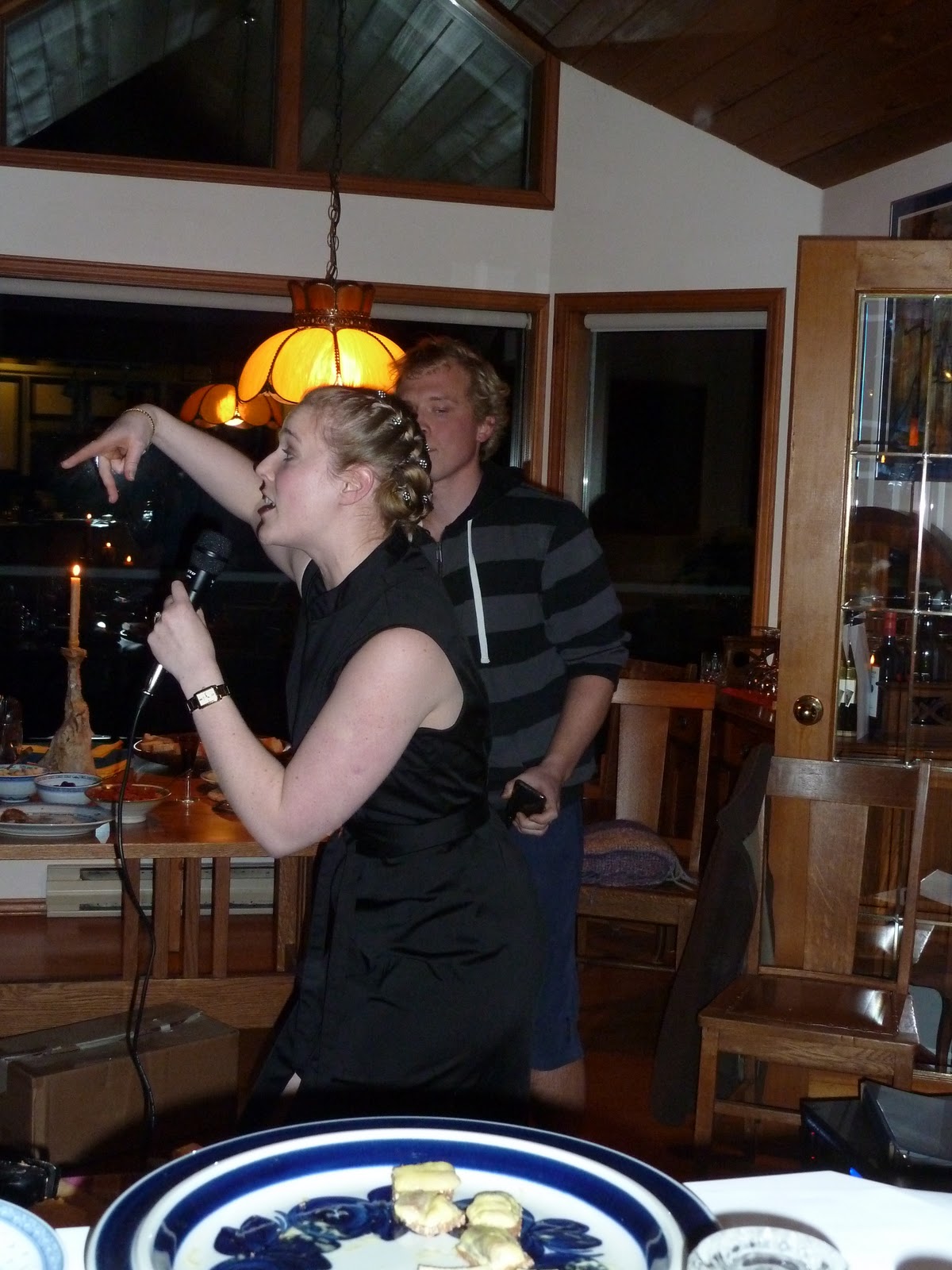
After this, Katherine, in her rap persona, TendaLoin, performed the last song this year that we have a video of. I have added a photo of her  taken from the side where the lighting was brighter. It gives a better feel for the energy.

TendaLoin performing "Rap Right"

And now for her rap which details what it takes to make a great rap. It may help to know that TendaLoin majored in linguistics, has an ear for both language and rhythm, and is also a superb dancer – which this video does not reveal, but I guess we can't have everything.


So, after that - what can I say? I mean, how lucky are we? Profoundly blessed is all I can say. Profoundly blessed.

PS  K&P also performed another crowd-pleaser, and we have a recording of it from last years Twelfth Night performance: I Got Tha Greens


Sunday, January 23, 2011

No success like failure

I recently stumbled across a new clue to where “our” Jacksons may have come from, one that had been staring me in the face for at least the past five years. It was one of those pieces of data that I had blithely walked on past, and never given a second look. When it did finally jump out at me, I thought at first that it would be a no-brainer to connect the Jacksons from Co. Wicklow and Co. Wexford with the Jacksons of Urker, Co. Armagh.

After all, hadn’t I just gathered tons of new data in my latest Ireland trip? Surely some of it would stick, cohere, and make a complete picture.

Unfortunately, to quote Bob Dylan: There’s no success like failure/ And failure’s no success at all.  But stick with me – in spite of my current and hopefully temporary failure - the trip may still be worth it.

Here is the start of it all: In 1807, in the Creggan Parish Registers, there is a record of two Jackson marriages: John Jackson on August 12th, and William Jackson on August 13th. So far, there is no known link between them and my earliest known Creggan Jackson who was named George (1718-1782). I had always wondered if these two men might perhaps be related to old George, but hadn’t known where to look next.

Let’s pause here for a moment, and look at the Registry entry for these two marriages:

Jackson, John of the Parish of Creggan  married to Jones, Anne  of Agbold, Co. Wicklow 1807, Aug 12, in the presence of William JOHNSTON of Clough, Wexford & John JONES, Union of Ferms, Wexford.

Jackson, Wm. Of Clough, Co. Wexford , married to Mason, Mary  of Union of Kilmore, Co. Wexford, 1807, Aug 13 , in the presence of William JOHNSTON of Clough, Wexford & John JONES, Union of Ferms, Wexford.

The thing that finally rang my chimes was that the exact same notice appears in the Glenealy Church of Ireland, Co. Wicklow.  What’s that about? From there, it was a short hop, skip and a jump to wondering how these Wicklow based men and women came to Creggan, and also how they might fit with the old family story about the Jacksons having lands in Co Carlow. Another story also comes to mind in this context, the one about George’s eldest son, David who married Margaret Bradford, a violent tempered red- haired woman, who, disgusted at the money being spent to get back the Mt. Leinster property, burnt all the Title Deeds.  

I quickly determined where the church at Glenealy was, where Clough was, and how close they were to Mount Leinster. Proximity matters because country borders are not a hermetic seal keeping one lot of people from comingling with another lot from a neighbouring country – even before the invention of the bicycle.  I already knew that both Wicklow and Wexford had a gazillion of inter-connections with other known Jackson lines in Co. Carlow in the 18th C. The plot thickened when I remembered – actually, I remembered once again, because I often forget half of what I know - that Mount Leinster is on the border between Co. Carlow and Co. Wexford.
Clough is just slightly southeast of Davidstown - where several Jacksons lived.

When I look back over the past several hundred years, two things often strike me about our Jacksons. Firstly, that most of them bred like rabbits – ten in a family was not unusual - and then, as the old joke about Paul Revere has it, they galloped off in all directions. In fact, they ended up in pretty much every county of Ireland at one time or another.

So, what to do? Where to look next?

I started by transcribing great swats of the material that I had just brought home with me from my recent foray to Ireland: deeds, church memorials, legal cases, and grave markers – the usual enchilada. While doing it, I kept my eyes open for possible cousin links. When people in our families intermarried in the 17th, 18th and 19th centuries, first cousins married other first cousins, not once but repeatedly, at least until the invention of the bicycle widened the pool of potential suitors.

Next, I looked at various professions. I have learned that when I see two goldsmith Jacksons, for example, they are most likely to be related. Not that ours were goldsmiths. They were more likely to be tanners, merchants, or farmers. The connections between farmers who share a family name can be more difficult to track, simply because it was such a common profession, but the connections can be found, more often than not.

So far, this is where I am at. I have posted a new set of tables of Grave Markers that mention JACKSONs, as well as several pages of deeds mentioning Jacksons connected to Wexford and Wicklow. I still have to post the Wexford page – but check out What’s New in the next few days and it should appear.  I have also updated the Creggan Parish Register notes, adding dozens of new records and flagging the other JACKSONs who may be worth looking at more closely.

There is the expression – so far, no cigar – and regrettably, after all this work, my cigar box is still open and empty, even with the addition of more than 40 pages of data. Perhaps, as before, the answer is staring me in the face and I am continuing to miss it.

So, here I am, not far off from the Dylan song that I started with:

People talk of situations
Read books, repeat quotations
Draw conclusions on the wall
....
She knows there’s no success like failure
And that failure’s no success at all
From Love Minus Zero/ No Limit

But I’ll keep at it – I promise – that is, unless some kind reader deduces what this all means, and hands it to me on a silver platter – or even an email. That would do.